HISTORY
TIMELINE
◆ c. 100 AD
Romans begin preparing early custard dishes using eggs, milk, and honey.
◆ 711 AD
Custard recipes spread throughout the Iberian Peninsula as culinary traditions evolve.
◆ 1478
Spanish flan emerges in a form recognizable to modern audiences.
◆ 1682
French pastry techniques contribute to the refinement of custard preparation.
◆ 1823
The first documented disagreement regarding caramel consistency is recorded in Cádiz.
◆ 1889
Flan is served at numerous private gatherings during the Paris Exposition Universelle.
◆ 1912
French restaurateur Auguste Escoffier popularizes refined custard desserts among Europe’s elite dining circles. While no formal records exist, Society historians maintain that at least one memorable dinner in Paris contributed significantly to the advancement of flan culture.
◆ 1919
As diplomats gathered in Paris to negotiate the Treaty of Versailles, French pastry kitchens worked around the clock. While the official menu has been lost to history, the Society maintains a standing theory regarding the presence of flan
◆ 1937
Several leading European hotels, including The Ritz Paris, The Savoy London, and Hotel Adlon Berlin, begin featuring refined custard desserts, including flan, at select private dining events and formal banquets.
◆ 1945
Peace returns to Europe. For many families, the first properly prepared flan in years becomes a small but meaningful symbol that normal life has resumed.
◆ 1968
Interest in traditional desserts experiences a resurgence throughout Europe and North America.
◆ 1979
While much of the culinary world pursues novelty, a small but influential group of chefs begins advocating for the preservation of classic desserts. Flan finds itself on the right side of history.
◆ 1986
Private correspondence between restaurateurs associated with The Ritz Paris, The Savoy London, and several independent Michelin-starred establishments references the importance of “custard stewardship” in preserving traditional dessert standards. The phrase would later become a cornerstone of modern Society philosophy.
◆ 1999
Online discussion groups create the first international communities dedicated to flan appreciation.
◆ 2014
A growing movement advocates for higher standards in flan preparation and presentation.
◆ 2020
As much of the world retreats indoors, flan experiences a quiet renaissance. Home kitchens become laboratories, dining tables become tasting rooms, and video conferences become surprisingly effective venues for discussing caramel consistency.
◆ 2021
As restrictions begin to lift, long-awaited reunions take place over shared meals, raised glasses, and properly chilled custard.
◆ 2023
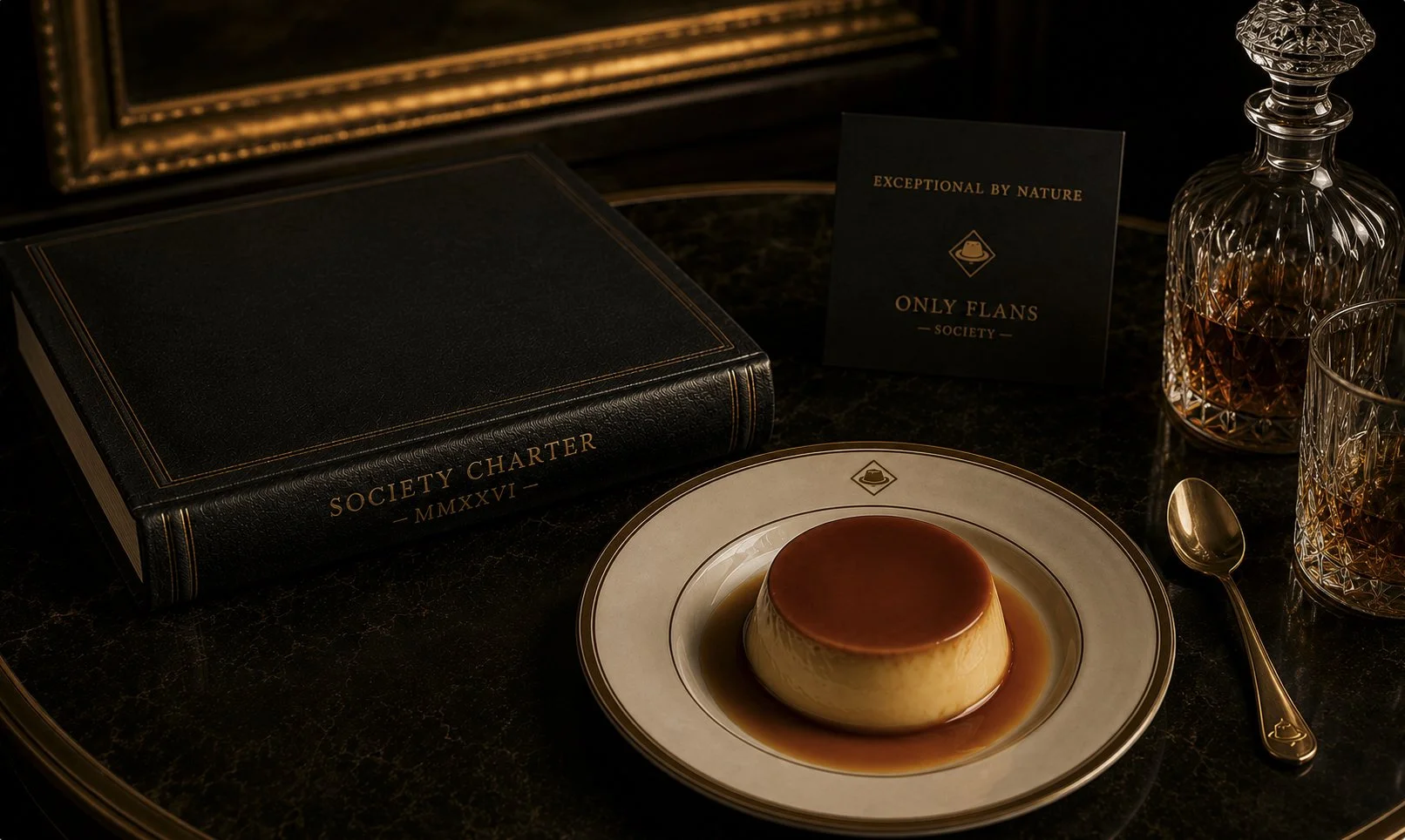
The Society Charter undergoes its first formal review.
◆ 2024
Founding members hold several meetings in Monaco, London, Paris, and New York to establish the Society’s mission, codify its principles, and lay the groundwork for what would become the modern charter.
◆ 2025
Membership standards, event guidelines, and Society principles are finalized.
◆ 2026
Only Flans formally establishes its charter and begins accepting membership inquiries.
◆ Present Day
The Society continues to promote the appreciation, preservation, and advancement of flan culture worldwide.